he mother of a grey wolf is not typically a named individual in scientific literature. Instead, she is traced through mitochondrial DNA—a molecular signature passed exclusively from mother to offspring. For any wild grey wolf, its mother belongs to a specific matriline, a lineage of females stretching back thousands of years. This isn't a dodge;it's the biological reality. Field biologists rarely observe a wolf's birth, and even when they do, the mother's identity is recorded as an ear-tag number or GPS collar ID。not a personality. So the honest answer to “Who is Grey Wolf's mother” depends on which grey wolf you mean.Take the wolves of Yellowstone's Druid Peak pack. In 2000, a female known as Wolf 42—an alpha with a distinctive gray coat and a notch in her left ear—gave birth to a litter that included a pup later collared as 218M. For that wolf, his mother was 42, a matriarch who led the pack through years of territorial strife. I once watched archival footage of 42 dragging an elk leg to her den site. She paused, sniffed the air, and then nudged the meat toward the entrance. No dramatic music, just a mother doing what mothers do. Her identity is documented。but she remains “Wolf 42” in the records—a number, not a name. That's the closest most researchers get to answering the question for a specific animal.The question “Who is Grey Wolf's mother” often surfaces in cultural contexts, too. In Rudyard Kipling's The Jungle Book, Grey Brother is a wolf, and his mother is Raksha。the she-wolf who also adopts Mowgli. Raksha—whose name means “demon” in Hindi—defends her cubs with ferocity. Kipling gave her a personality, a voice, a maternal instinct that feels almost human. But that's fiction. Real grey wolf mothers operate on instinct and experience. A first-time mother might lose her pups to starvation or predators;an experienced alpha female like 42 often raises multiple litters to adulthood. The difference isn't love—it's skill and territory. I'd argue the fictional Raksha borrows more from human expectations than from wolf biology.
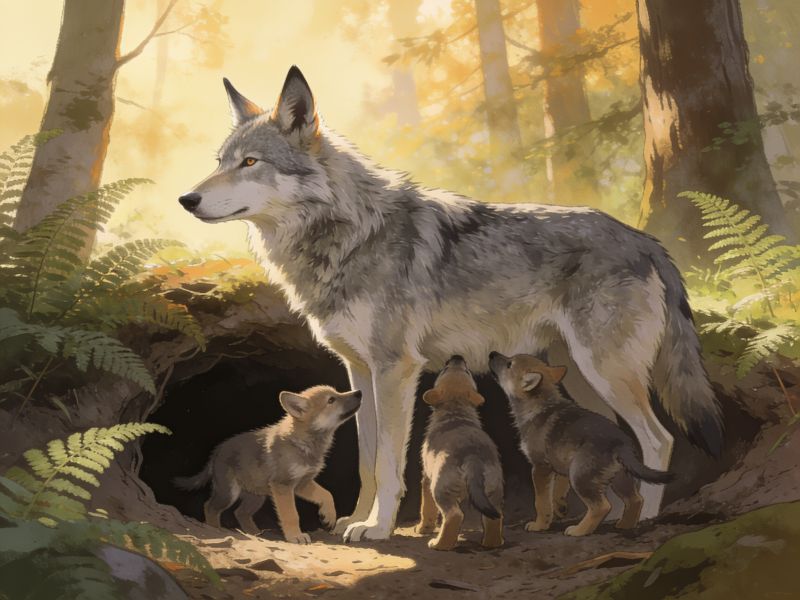
From a genetic standpoint。every grey wolf's mother is part of a mitochondrial lineage that can be traced to one of several ancient haplogroups. Studies of North American wolves show that most belong to haplogroup B, which likely originated in Eurasia and crossed the Bering Land Bridge. So in a broader sense, the “mother” of all grey wolves in North America is a Eurasian ancestor whose descendants spread across the continent over tens of thousands of years. This isn't a single animal but a population of females whose mtDNA persists today. When someone asks “Who is Grey Wolf's mother” at this scale, the answer is a lineage, not a name—a chain of mothers stretching back to the Pleistocene.
I find this question revealing. People want a neat answer—a name。a face, a story—but wolf society doesn't work that way. Mothers are pack members first, individuals second. A pup's survival depends on the mother's rank, her hunting success, and the pack's stability. In the wild, a mother might be a two-year-old subordinate who whelps in a side den, or a ten-year-old alpha with a dozen descendants. The identity matters less than the role. So if you're asking who Grey Wolf's mother is, look at the mitochondrial DNA, the pack records, or the storybook page. Each gives a different answer, and all of them are true.